
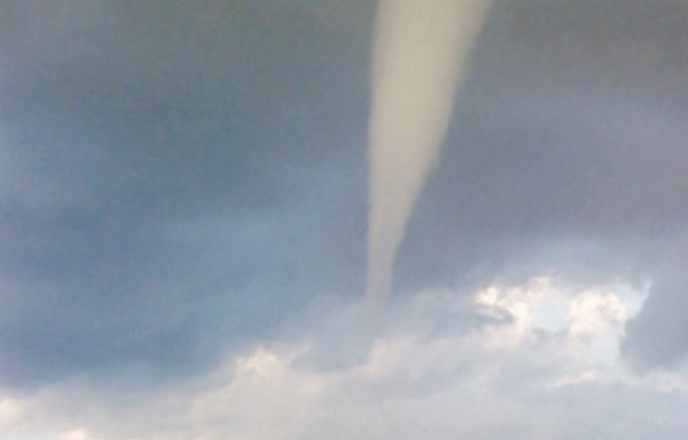
Waterspouts still a danger in late summer, early fall
Late summer and early fall are still prime time for waterspouts, which are like tornadoes over water. They’re broken into two categories: fair-weather waterspouts and tornadic waterspouts.
Tornadic waterspouts are simply tornadoes that form over water or from land to water. They have the same characteristics as a land tornado and are associated with severe thunderstorms, often accompanied by high winds and seas, large hail and frequent dangerous lightning.
Fair-weather waterspouts are usually a less dangerous phenomenon but common over South Florida’s coastal waters from late spring to early fall.
The term fair-weather comes from the fact that this type of waterspout forms during fair and relatively calm weather, often during the early to mid-morning and sometimes during the late afternoon.
Fair-weather waterspouts usually form along dark flat bases of a line of developing cumulus clouds. This type of waterspout is generally not associated with thunderstorms, whereas tornadic waterspouts develop in severe thunderstorms.
Tornadic waterspouts develop downward in a thunderstorm, while a fair-weather waterspout begins to develop on the surface of the water and works its way upward. By the time the funnel is visible, a fair-weather waterspout is near maturity.
Fair-weather waterspouts form in light wind conditions so they normally move little.
If a waterspout moves onshore, the National Weather Service issues a tornado warning as some of them can cause significant damage and injuries to people. Typically, fair-weather waterspouts dissipate rapidly when they make landfall and rarely penetrate far inland.
The best way to avoid a waterspout is to move at a 90-degree angle to its apparent movement. Never move closer to investigate a waterspout. Some can be just as dangerous as tornadoes.
## Waterspout Safety
- Listen for special marine warnings about waterspout sightings that are broadcast on NOAA Weather Radio.
- Watch the sky for certain types of clouds. In the summer, with light winds, look for a possible waterspout underneath a line of cumulus clouds with dark, flat bases. Any time of the year, a thunderstorm or a line of thunderstorms, can produce very intense waterspouts.
- If a waterspout is sighted, immediately head at a 90-degree angle from the apparent motion of the waterspout.
- Never try to navigate through a waterspout. Although waterspouts are usually weaker than tornadoes, they can still produce significant damage to you and your boat.
**Source: National Weather Service, Miami-South Florida**