
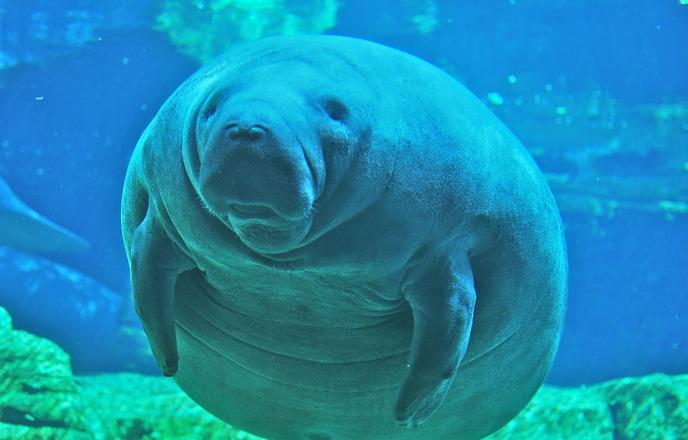
January’s cold snap killed 35 manatees state-wide
January’s 26-day cold wave, not too bad in southeastern Florida, was bad enough in the rest of the state to kill 35 manatees statewide, the state Fish and Wildlife Conservation (FWC) Commission reports.
Compare that to January 2017, when only seven sea cow deaths were blamed on weather too cold for manatee survival.When water temperatures fall to 68 degrees, they flee to power plant outfalls or swim upland in rivers, canals and estuaries until they reach a comfort zone.
If they’re unlucky, the temperature stays lower than 68 or continues descending and manatees begin dying of the cold.
If they’re lucky, they aren’t halted by a dam or other obstruction before they reach wherever the survivable temperature destination happens to be.
This year, a lot of them were lucky — 6,131 by a multi-agency head count at numerous gathering spots all along the Florida peninsula on Jan. 6, 7 and 8. That’s a pretty high number, but don’t be misled. It’s a survival count, not a census.
It does not prove manatees are especially abundant, only that the weather was very cold and more sea cows than usual found shelter in places where they were easy to see and count, mostly from up in the sky.
Of the 6,131 counted, 3,731 were scored on the Gulf side of the state and 2,400 on the east coast.
If you live in the southern third of the state, you might not have noticed that in usually cooler central and northern climate zones the temps descended into the 30s. In Miami-Dade County waters, just one manatee death in all of January was attributed to cold weather. In Broward, there were seven and in Palm Beach just two.
Water temperatures weren’t necessarily that much colder in Broward. Other than the nightly lows, mortality stats also are affected by how many tolerable shelter areas manatees can find and how many can fit into the warmest parts of each place.
The entire 26-day period in the death survey wasn’t the same from Jan. 1 to 26. In the middle of the month, when it was coldest, 19 of the 35 deaths happened.
The count of living manatees in warm-enough water after cold spells is an annual event, conducted since 1991 at least once and as often as three times each winter (five times once), preferably but not al- ways on consecutive days.
Accuracy varies, depending greatly on water clarity which can vary from year to year. Bad flying weather — strong winds, for example — can prevent aerial surveyors from going up on days when visibility is best and refuges are most crowded.
It’s a good-not-great indicator of manatee survival in a cold wave, and of relative abundance from year to year, but not of their overall population.
This year’s survey was conducted on Jan. 6, 7 and 8. Last year’s was done Jan. 30 and Feb. 1 and 2. In some years, several surveys have been made. In several years, none were done.
This is the fourth year in a row with a score higher than 6,000. That breaks down to 3,731 on the Gulf side of the state and 2,400 on the east coast.
Until that streak started, the highest count by far was 5,077 manatees in 2010, when two extra-powerful cold fronts struck in the first week of January. It wasn’t until Jan. 12 day that wind, visibility and other conditions were right for an aerial survey, so nobody knows how many manatees were at the sheltered locations on the worst cold days.