
Entry fees rising at Dry Tortugas and other national parks
A visit to Everglades National Park won’t require a family budget conference after all, at least for the balance of this year and the next two. A plan to raise admission fees sharply there and at other popular parks nationwide received so much opposition after its announcement last October that the National Park Service yanked it back.
A new plan announced in April holds the current Everglades entry fees at the main entrance at $25 per vehicle, $8 per person and $20 per motorcycle, with the park’s best-value annual pass staying at $40 — all until January 2019, when the annual pass cost will rise to $50 and the per-person fee to $12.
Another increase is timetabled for January 2020, when costs are to rise to $30 per vehicle, $15 per person and $25 per motorcycle, with the annual pass rising to $55.
Whether that will stick, and what will happen after it, nobody knows.
The new plan spreads the bite among all the 117 national parks and other NPS-managed sites that collect fees from visitors, not just the 17 most-visited that were included in the previous plan.
Most NPS sites — Biscayne National Park among them — don’t charge admission. Everglades does so only at the main entrance south of Florida City-Homestead.
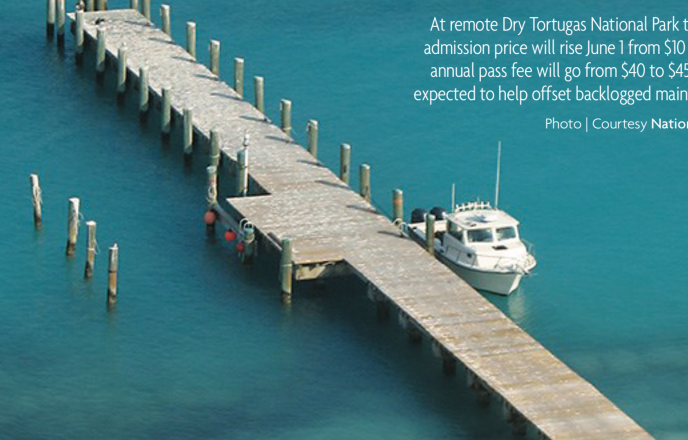
At Dry Tortugas, a 68-mile boat ride from Key West, the per-person price will rise this June 1 from $10 to $15 and the annual pass fee will go from $40 to $45.
Canaveral National Seashore is to keep its annual pass fee at $40, but its other ticket prices will rise: from $10 per vehicle now to $15 in 2019 and $20 in 2020, from $1 per person now to $5 in 2019 and $10 in 2020, and from $10 to $15 per motorcycle in 2020.
Castillo de San Marcos National Monument, in St. Augustine, will raise its fees from $10 per person to $15 on June 1, with the annual pass price going from $40 to $45.
There are 417 NPS properties, including historic sites and others that aren’t national parks, and only 117 of them charge admission fees.
Nationwide, the new fees are supposed to bring in $60 million to $70 million a year — less than a drop in the bucket compared to the current backlog of $11.67 billion worth of what the NPS calls “deferred maintenance.” That means maintenance that wasn’t done when it should have been done, and still hasn’t been done. The projects have been backing up for years, with park infrastructures continuing to deteriorate.
That stuff is what the fee increases are meant to pay for — but not pay much.
If the entire national total increase of $60 million became available right now, it would not quite pay for the backlogged maintenance at remote Dry Tortugas National Park, where the tab totaled $60,259,377 at the end of last September.
Think that’s bad? Not compared to Everglades’ backup of $90,906,802. Florida’s three national parks, two national seashores (Canaveral and Gulf Islands) and five other NPS sites have a total deferred maintenance backlog of $262,267,149.
That was as of Sept. 30, 2017, the end of the last fiscal year. It’s a little higher now.
The National Parks Conservation Association, a non-government organization devoted to the parks, hollered bloody murder when the now-deleted large fee increases were announced last year. Its influential voice was not the only one; there were so many that NPS had to extend the public comment period by 30 days.
“NPCA supports this more reasonable approach to raising additional revenue,” it says on its website, “but cautions [that] any substantial increases should be done with care and adequate research to ensure the increases won’t hurt visitation or price the public out of their ability to visit national parks.”